At a glance
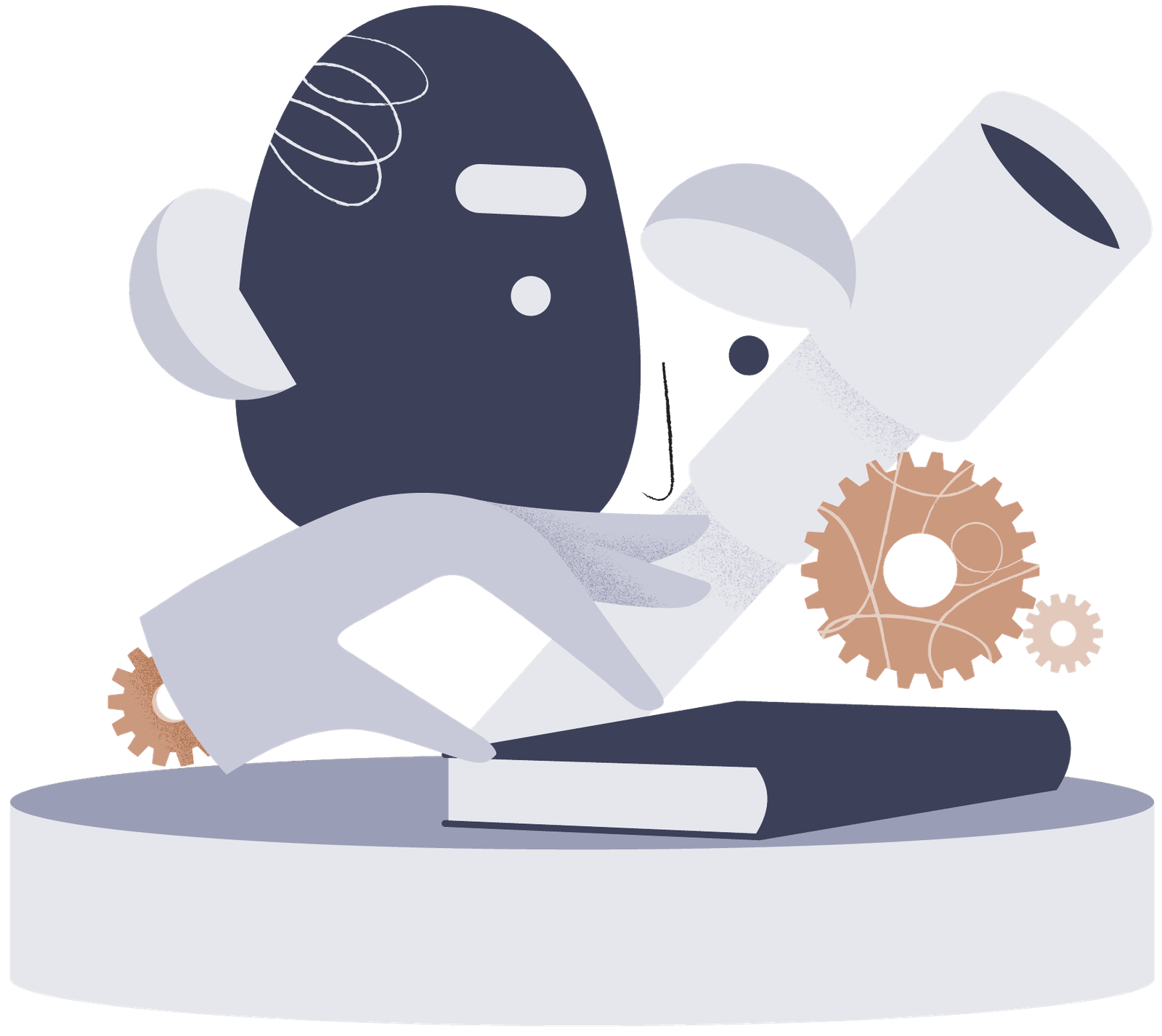
Fives want to understand the world before they engage with it. They observe, analyze, and take things apart to see how they work, and they'd rather know everything there is to know about a situation before they act on it.
Fives are good at thinking clearly under pressure. Where it gets harder is stepping out of the analysis and actually taking part in life, since staying in the lookout post can start to feel safer than coming down into the crowd.
**
Fives collect knowledge the way some people collect anything else: steadily, and with real curiosity about whatever currently has their attention. They'd rather work something out for themselves than take someone else's word for it, and they trust a conclusion more once they've reasoned their way to it.
That same clarity is what lets a Five stay calm when everyone else in the room has already lost their footing. The cost is on the other side of the same coin: Fives are often better at taking in information than offering up anything personal about themselves. Sharing something private can feel like it hands other people a claim on their time and attention, so a Five tends to ration it carefully.
Fives want to feel capable of meeting a world that can feel like it's asking too much of them. The unspoken logic is that the more they understand, the less that world can catch them off guard.
Fives belong to the head group of the Enneagram , along with Type 6 and Type 7, the three types with a particular relationship to fear and anxiety. Sixes use their mind to scan for danger. Sevens use it to stay ahead of anything that might take their happiness away. Fives use theirs to study the fear itself, reduce how much space they take up in the world, and trust that staying objective will keep them from being pulled under by it.
As children, everyone experiences the world as something mysterious and a little overwhelming. For Fives, that feeling doesn't fully go away. Somewhere along the way, many pick up the sense that they're not naturally equipped to handle what life asks of them, and they respond by working to become genuinely competent in whatever area they've chosen to focus on.
Fives often operate as if they can only really join the world once they've worked out how to do it safely, from inside their own head first. They treat their time, energy, and attention as a limited resource, and once it starts running low, they put distance between themselves and whatever's asking for more of it.
The same instinct that makes a Five good at gathering knowledge can make it hard to actually use it. They can spend a long time in preparation mode, turning an idea over and refining it, without ever putting it in front of anyone. Whatever's inside stays inside.
Healthy Fives know they have something real to offer and aren't afraid to put it out there. They can share what's in their mind with real clarity, and they can feel an emotion without needing to first take it apart and explain it to themselves. That same drive to go past what's already known is also what lets healthy Fives become genuine pioneers in whatever they've chosen to study.
The thing worth a Five hearing: the world isn't as scarce as it feels from inside your own head. Sharing what you know and what you have doesn't leave you with less. There's no version of "ready enough" you need to hit before you're allowed to take part.
Fives bring real depth to a team: once they've taken something on, they understand it thoroughly, and they don't offer an opinion without having actually thought it through. Colleagues can trust a Five's answer to hold up under scrutiny.
The friction point is usually access. A Five can go quiet when they're still working something out, which can read as disengagement even when it's the opposite. They tend to do well in roles that reward depth over speed: research, analysis, engineering, specialist work where being right matters more than being fast. Environments that demand constant availability or real-time emotional responsiveness are harder for a Five. That mode drains them fast, regardless of how much they care about the outcome.
What helps a Five thrive at work: real, protected time to think before being asked to respond, and a team that treats "let me look into it" as a legitimate answer instead of a stall.
Under stress, Fives can take on some of the less healthy traits of Type 7: scattering their attention across a dozen new interests instead of committing to one, using constant intellectual stimulation to avoid an uncomfortable feeling instead of sitting with it.
In growth, Fives move toward the healthier traits of Type 8: more willingness to act on what they know instead of continuing to prepare, more confidence taking up space and asserting an opinion instead of staying on the sidelines.
Every type can lean toward one of its two neighbors. For Fives, that's Type 4 or Type 6.
more emotionally expressive, better able to feel something and say so instead of just analyzing it. This combination is often drawn to unusual, creative uses of their mind and likes to tinker with ideas as much as facts.
more practical and group-oriented, pairing a Five's observation with a Six's eye for what could go wrong. This combination tends to be more socially engaged and more focused on stability, for themselves and the people around them.
Wings
Explore Type 5 wings
Personality isn't fixed. People move between healthier and less healthy expressions of their type depending on the season of life, the stress they're under, and how much self-awareness they're bringing to it. Here's how that range shows up for Fives. These are patterns, not a diagnosis.
Unhealthy Fives** become isolated inside their own head, fixated on ideas rather than on the anxiety that's actually driving them there. Some keep collecting and refining knowledge without ever using it. Others fall into narrow, trivial rabbit holes that have stopped serving any real purpose. Either way, real life, relationships, and sometimes basic self-care start to slip.
Average Fives** are productive, focused thinkers who need the occasional reminder that there's a world happening outside their own analysis. They build their identity around what they know and around having something genuinely insightful to say, often carving out a specific niche where their competence isn't in question. Real engagement takes a back seat to studying engagement from a safe distance.
healthy expressions of their type depending on the season of life, the stress they're under, and how much self-awareness they're bringing to it. Here's how that range shows up for Fives. These are patterns, not a diagnosis.
Healthy Fives lose the fear that engaging will drain them. They give back what they've spent years working out in their own heads, and they get comfortable sharing more than just information: their time, their feelings, their actual presence. Albert Einstein and Charles Darwin are often cited as examples of Fives operating at this level.
It's common not to be sure of your type right away. The Enneagram looks at the motivation behind a behavior, not just the behavior, so different types can look similar from the outside.
Type 5s are most often confused with Type 9s. Some also mistype as a Type 8. Since every type has two possible wings, it's also worth checking whether your "wing" might actually be your core type.
Read the full guide to Type 5 mistypes
Mistypes
Type 5 lookalikes
Type 5 patterns show up in love, friendship, and work. The compatibility guide covers how this type pairs with all nine types, including another Type 5.
Relationships
Type 5 with each type
Albert Einstein
Angela Merkel
Stephen Hawking
Bill Gates
Agatha Christie
Stephen King
Charles Darwin
Vincent van Gogh
Reconnect with your body, not just your mind. You're more than what you can reason your way through. Pick something physical you can return to regularly: a sport, a walk, a practice that puts you in your body instead of in your head.
Get comfortable not knowing. No one has the answers to everything, and you don't need every question resolved before you're allowed to act.
Practice sharing before you feel ready. Letting someone in doesn't automatically cost you something. Trust a few people not to use what you've shared against you.
Use what you've gathered. Knowledge and skill that stay in your head help no one, including you. Look for a real place to put what you know to work.
Extend yourself the same generosity you'd extend anyone else. You're allowed to take up space, spend your resources, and want things without a justification attached.
Reconnect with your body, not just your mind.
You're more than what you can reason your way through. Pick something physical you can return to regularly: a sport, a walk, a practice that puts you in your body instead of in your head.
Get comfortable not knowing.
No one has the answers to everything, and you don't need every question resolved before you're allowed to act.
Practice sharing before you feel ready.
Letting someone in doesn't automatically cost you something. Trust a few people not to use what you've shared against you.
Use what you've gathered.
Knowledge and skill that stay in your head help no one, including you. Look for a real place to put what you know to work.
Extend yourself the same generosity you'd extend anyone else.
You're allowed to take up space, spend your resources, and want things without a justification attached.
Nine types
Type 1
Ones are idealistic and conscientious, with a strong sense of right and wrong and a real commitment to doing things well. They act with discipline and can put off a short-term reward for a better outcome later. Ones are

Type 2
Twos are generous and warm, with a genuine drive to make the people around them feel loved and comfortable. They notice what someone needs, sometimes before that person does, and they're quick to offer it: their time, th

Type 3
Threes are driven, adaptable, and hardworking. They believe in their own ability to grow their talents and get things done, and they're quick to read a room and become whoever that room needs them to be to win its approv

Type 4
Fours are introspective and expressive, with an unusually direct line to their own emotions. They're comfortable in parts of human experience most people avoid: grief, longing, the strange, the dark. They care about mean
Type 5 · here
Fives want to understand the world before they engage with it. They observe, analyze, and take things apart to see how they work, and they'd rather know everything there is to know about a situation before they act on it
Type 6
Sixes are reliable, loyal, and careful. They notice what could go wrong before anyone else does, and they put real effort into being ready for it. People count on a Six to follow through, to ask the question no one else

Type 7
Sevens are energetic and quick to see the possibilities in a situation. For a Seven, the world is mostly a place worth exploring, and they live with an eye on what's next. They're often the person in the room who can fin
Type 8
Eights move through the world with a lot of energy and a low tolerance for being told what to do. They notice power dynamics quickly, in a room or a relationship, and they'd rather be the one setting the terms than the o

Type 9
Nines are easygoing, grounded, and unselfish. They want peace, in their own inner state and in the environment around them, which is why they're often the ones a group turns to for mediating. Nines are genuinely good at
Think Type 5 might be you?
Take the free test and see how The Investigator shows up for you.
